The Great Compression
The water is getting shallower. And everything is becoming visible.

The water is getting shallower. And everything is becoming visible.
For a very long time, the water was deep. Deep enough to hide almost anything. Ineffective leadership. Passive contribution. Bureaucracy masquerading as process. Organizational drag that nobody named. Entire careers built on looking valuable instead of creating value.
In deep water, everyone looked like they were swimming. A leader could spend fifteen years mastering presentations, politics, visibility, stakeholder management, and executive language, without ever truly creating movement. A company could confuse complexity for sophistication. A professional could confuse being busy with being useful. And because the water was deep enough, the difference was almost impossible to see.
For decades, modern organizations were built around this depth. Information moved slowly. Accountability surfaced slowly. The distance between appearance and reality could stretch for years. Sometimes decades.
But the water has begun to recede, quietly. A little more visibility. A little more speed. A little less protection between contribution and measurement. We are barreling towards The Great Compression. Instant communication. Radical transparency. Shrinking execution cycles. Relentless visibility.
The water is getting shallower now. And shallow water reveals everything.
Who creates movement. Who absorbs it. Who builds trust. Who spreads fear. Who simplifies. Who complicates. Who amplifies momentum. Who quietly kills it. The leaders who were always exceptional are becoming impossible to miss. The leaders who only ever looked exceptional are becoming impossible to hide.
The real story of the AI era is not automation. It's exposure. Artificial intelligence is not merely changing work. It is collapsing the distance between contribution and visibility, between leadership and impact, between performance and reality. For the first time in modern organizational history, systems are beginning to reveal what humans actually create around them.
I think people can already feel it. The instability. The exhaustion. The strange sense that entire professional identities are quietly becoming fragile under acceleration. Because deep down, many people understand something they cannot yet fully articulate: the old hiding places are disappearing. The humans who survived through opacity, bureaucracy, process dependency, political fluency, and strategic invisibility can feel the water receding beneath them.
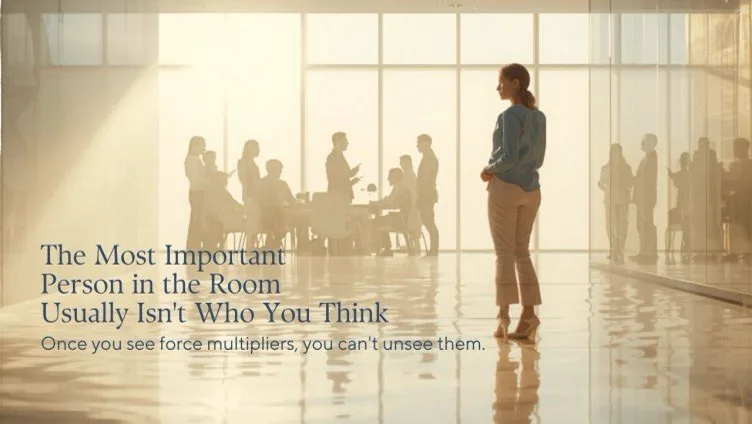
Meanwhile, another kind of human is becoming increasingly visible. The humans who create movement. Not always the loudest. Not always the most credentialed. Not always the most polished. But systems become calmer, clearer, faster, healthier, and more alive when they enter them. Problems shrink. Momentum returns. Trust expands. These humans do not merely perform. They amplify. I call them force multipliers. And once you learn to see them, you cannot unsee them.
The executive who makes the entire room smarter when pressure rises. The operator who quietly removes friction no one else even noticed. The leader who creates calm instead of panic. The employee with no impressive title whose presence somehow accelerates every team around them.
And then you begin noticing the opposite too. The humans who slow movement, inflate complexity, drain momentum, and quietly increase the emotional gravity inside every room they enter. Once the water gets shallow enough, the difference becomes impossible to ignore.
That is what is happening to the modern economy right now. The AI era is not eliminating human value. It is revealing it. That realization is what I have spent twenty five years building toward. I have been close to leaders and organizations long enough to see the pattern clearly. To understand the difference between the leader who looks right and the one who actually is. To know what force multiplication looks like before a hire is made rather than eighteen months after.
Over the next month, I am formally launching Anchor Point's executive search practice. We have engaged in executive search over the years less formally based on trusted executive relationships, and it's been a true passion for me. Now, I'm formalizing my methodology for identifying force multipliers as the foundation for our practice. Built for the compressed era. Built around force multipliers. Built on the conviction that finding the right leader has never been more consequential than it is right now.
It starts here. In the compression. Where everything is finally becoming visible.
The Signal
Observations like this, delivered directly.
No spam. No filler. Just the patterns that matter.