Imposter Syndrome, Part II: The Casting Director Called. Matt Damon got the part.
Recognition doesn't create reality. It just catches up to it.
Christopher Nolan's The Odyssey opens in theaters this week. Early reactions have focused on its cinematic spectacle, all-star cast, and the story of a man trying to find his way home after twenty years of war. Media hype over the weekend surfaced my memories of a beloved classic, and a scene that has stayed with me. It isn't the Cyclops or the Sirens or any of the monsters we typically remember. It's what happens after Odysseus finally makes it home.
This isn't ancient history, it's Monday morning.
Athena disguises Odysseyus as a beggar before he ever reaches his own palace. He walks into his own hall and watches strangers eat his food, spend his money, and compete for his wife's hand. His own son doesn't recognize him. His old dog, Argos, waited twenty years for this moment. He lifts his head, sees his master, and dies where he's been lying on the dung heap. Later, an old nurse washing his feet in the dark discovers the truth only because her hands find a scar on his leg.
That's the entire welcoming committee: a dying dog and a pair of hands in the dark, after twenty years of being the rightful king.
The older I get, the more I think the trip home was never the hard part. The hard part starts after he's already back. It's about recognition, about what it feels like to know exactly who you are while the world is still working from an outdated version of you.
I used to think imposter syndrome meant I couldn't see myself clearly. But sometimes the problem isn't that you've underestimated who you've become. Sometimes everyone else is still working from an older script. Human beings are remarkably slow to update identity. We promote people faster than we redefine them, and we change titles before we change stories. By the time the room catches up, you've already become someone else.
If you've built anything worth keeping, you've lived some version of this. Not the monsters. The meeting where you've done the work, earned the seat, solved the actual hard problem, and you're still watching someone look through you like you're a convincing hologram of yourself.
Imposter syndrome rarely sounds or feels like panic. It's much more polite than that. It simply leaves an asterisk beside everything good that happens.
Temporary.
Borrowed.
Don't get comfortable.
Like a tiny, invisible auditor who never clocks out or takes a vacation.
I've noticed what happens when a completely capable person starts believing the asterisks. The organization doesn't just lose their confidence, it loses the actual force they were generating: decisions slow down, conversations get smaller, and the clarity she'd built starts clouding over again.
Next Homer does something brilliant. When Odysseus finally reveals himself to Penelope, she doesn't believe him. Of course she doesn't. Twenty years is a long time, and plenty of men have probably claimed to be the missing king.
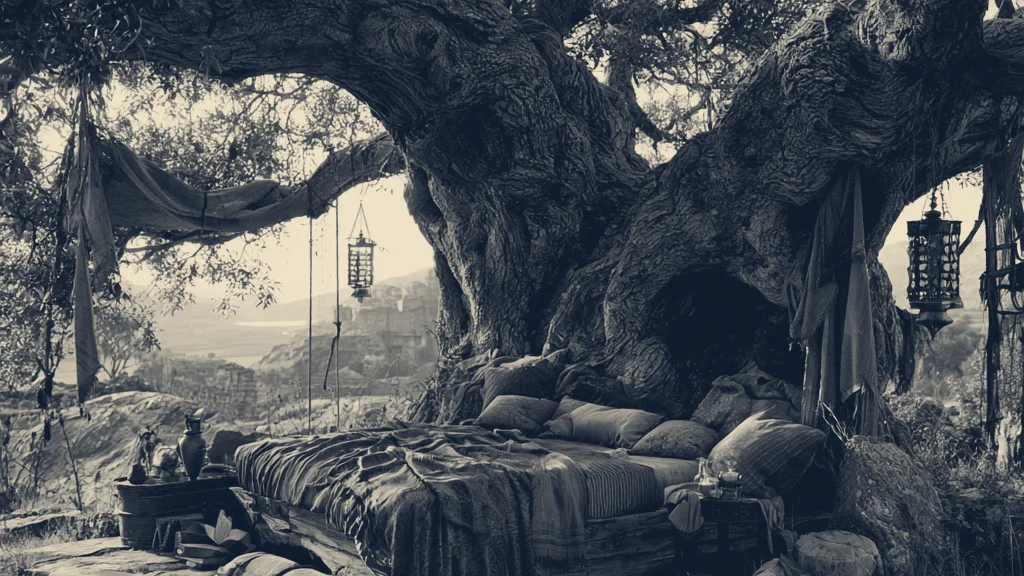
So she tells a servant to move their marriage bed. Odysseus objects immediately: he built that bed himself, carving it from a living olive tree still rooted in the ground, then built the room around it. You could no more move that bed than move the house it was growing out of.
No servant could have known that. No imposter who'd studied his walk for years could have faked it, it was something he'd lived through building, long before there was any audience to perform it for. Penelope isn't testing what he remembers, she's verifying his identity. She's testing what only the real Odysseus could possibly know, because he's the only one who was there when it was built.
That's not confidence, it's evidence. Confidence comes and goes and carries external context. Evidence doesn't, because the olive tree was there whether anyone ever recognized it or not.
Most of us have an olive tree of our own. Some scar earned, some hard fought battle worn or lost, some significant milestone that changed the way we've read every hard problem since. Nobody can shortcut their way to it, and nobody can fake it by studying us closely enough. It has to be lived first, slowly, with no guarantee anyone will ever ask to see it. The important parts of who we are aren't learned, they're accumulated.
That's what the voice inside us keeps forgetting: recognition doesn't create reality. It just catches up to it.
In Imposter Syndrome, Part I, the lesson I learned was that there was never a casting director. The second lesson is that there isn't really an audience with the authority to decide whether you belong, either. The room doesn't make you the leader any more than Penelope makes Odysseus the king. It eventually recognizes what has already become true.
One ordinary Tuesday you look up and realize you've been carrying the scene for a long time. Not because anyone cast you in the role or ever had the authority to do so. Because you stayed when it was hard, kept showing up when the voice in your head said you didn't belong, and went to live rehearsals so many times it wasn't acting anymore.
Matt Damon has said he answered yes before he even knew what the project was because Nolan was director. But that certainty didn't teach his hands to draw a bow. That came from months alone in a Brooklyn apartment, running the same motion thousands of times while nobody was filming and nobody was grading him, until his hands knew what to do by instinct.
Nolan called, Damon got the part.
The Signal
Observations like this, delivered directly.
No spam. No filler. Just the patterns that matter.